

Incoterms 2020: What Incoterms are and how they are directly connected to cargo insurance.

In a globalized environment where cargo transport is a critical part of the supply chain, clarity in delivery terms is essential. Incoterms (International Commercial Terms), published by the International Chamber of Commerce (ICC), were created to precisely define the responsibilities, costs, and risks that sellers and buyers assume in international commercial transactions.
Choosing the right Incoterm affects not only the flow of transportation but also risk coverage, insurance requirements, and the actual cost of a shipment.
What Are Incoterms?
They are a set of 11 internationally recognized rules that define:
- Who is responsible for transportation costs
- Who assumes the risk of damage or loss
- Who handles customs procedures
- Where and when delivery takes place
Incoterms are not a contract on their own, but they supplement the sales agreement by clarifying critical aspects and helping to avoid misunderstandings and legal disputes.
The 11 Incoterms Explained Simply and Practically
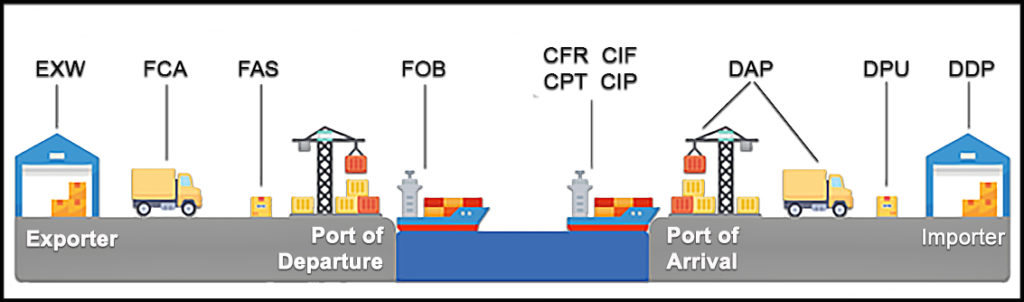
- EXW – Ex Works
The seller simply makes the goods available at their premises. The buyer assumes all transportation, costs, and risks. - FCA – Free Carrier
The seller delivers the goods to the carrier chosen by the buyer. - FAS – Free Alongside Ship
The seller places the goods next to the vessel at the port of shipment. The buyer handles loading and transport. - FOB – Free On Board
The seller loads the goods onto the ship. The buyer pays the freight and arranges insurance. - CFR – Cost and Freight
The seller pays the freight to the destination port, but risk transfers to the buyer once the goods are loaded onboard. - CIF – Cost, Insurance and Freight
Same as CFR, but the seller also pays for insurance. One of the most widely used terms in maritime trade. - CPT – Carriage Paid To
The seller pays transport to the agreed destination, but risk transfers to the buyer when the goods are handed over to the carrier. - CIP – Carriage and Insurance Paid To
Same as CPT, with the added obligation for the seller to pay for insurance. - DAP – Delivered At Place
The seller delivers the goods ready for unloading at the place designated by the buyer. - DPU – Delivered at Place Unloaded
The seller is also responsible for unloading the goods at the destination. - DDP – Delivered Duty Paid
The seller assumes all costs, risks, and import duties up to the buyer’s premises. The most “seller-heavy” term.
Why Are Incoterms Directly Linked to Cargo Insurance?
The chosen Incoterm determines when the risk of damage or loss transfers from the seller to the buyer.
This means:
- Under certain terms (e.g., FOB, CFR, EXW), the buyer must arrange their own insurance.
- Under others (e.g., CIF, CIP), the seller is required to provide insurance, but often with minimum coverage, which may not adequately protect the buyer.
- An incorrect Incoterm choice can leave part of the shipment uninsured during the transport process.
Conclusion
Incoterms form the foundation of safe and efficient international trade transactions. Understanding them and using them correctly helps reduce costs, prevent risks, and ensure smooth transportation.
For specialized advice on Incoterms and the appropriate cargo insurance coverage, our team is always at your disposal.
The information, assessments, and statements contained in this document are provided for informational purposes only. While our company strives to ensure that the content is accurate and up to date, no warranties, express or implied, are given regarding the completeness, accuracy, or suitability of the information.
Any evaluations and conclusions are presented impartially and do not constitute legal, technical, or financial advice. The company accepts no liability for any direct or indirect damages that may result from the use of this information.